Why Most AI-Generated Leads Don't Convert (And How to Fix Your Funnel)
Direct answer: AI-generated leads usually fail to convert for one of three reasons: the targeting was too broad and pulled in people who were never going to buy, the data behind the leads was outdated or mismatched to your actual buyer, or the follow-up system that should turn an interested contact into a customer simply didn't exist. AI is genuinely good at increasing the volume of leads entering your pipeline. It does nothing to fix what happens — or doesn't happen — after that. Fixing conversion means fixing the system around the leads, not generating more of them.
Why This Matters
There's a quiet but significant gap between what small businesses expected from "AI " and what they're actually getting. According to a widely cited 2024 Adobe survey, only 39% of business leaders said AI-generated leads converted at a higher rate than traditional methods — the rest saw no improvement, or a decline. More strikingly, up to 79% of leads across all generation methods never convert to a sale at all and the reason usually isn't lead quality. It's that the follow-up system breaks down before the lead ever gets a real chance to buy.
This creates a frustrating cycle: a business turns on an AI tool, watches the lead count climb and then watches the sales number stay flat — or drop, because the team is now spending hours manually reviewing and filtering a larger pile of low-quality contacts. Roughly 44% of organizations report manually reviewing every AI-generated lead list to weed out junk, which quietly cancels out the efficiency the tool was supposed to deliver.
None of this means AI doesn't work. It means most small businesses are using it to solve the wrong problem. AI is excellent at expanding the top of your funnel. It cannot fix a funnel that has no qualification step, no follow-up cadence, or no clear definition of what a "good" lead actually looks like for your specific business. If those things are missing, AI just makes the gap more visible — and more expensive — faster.
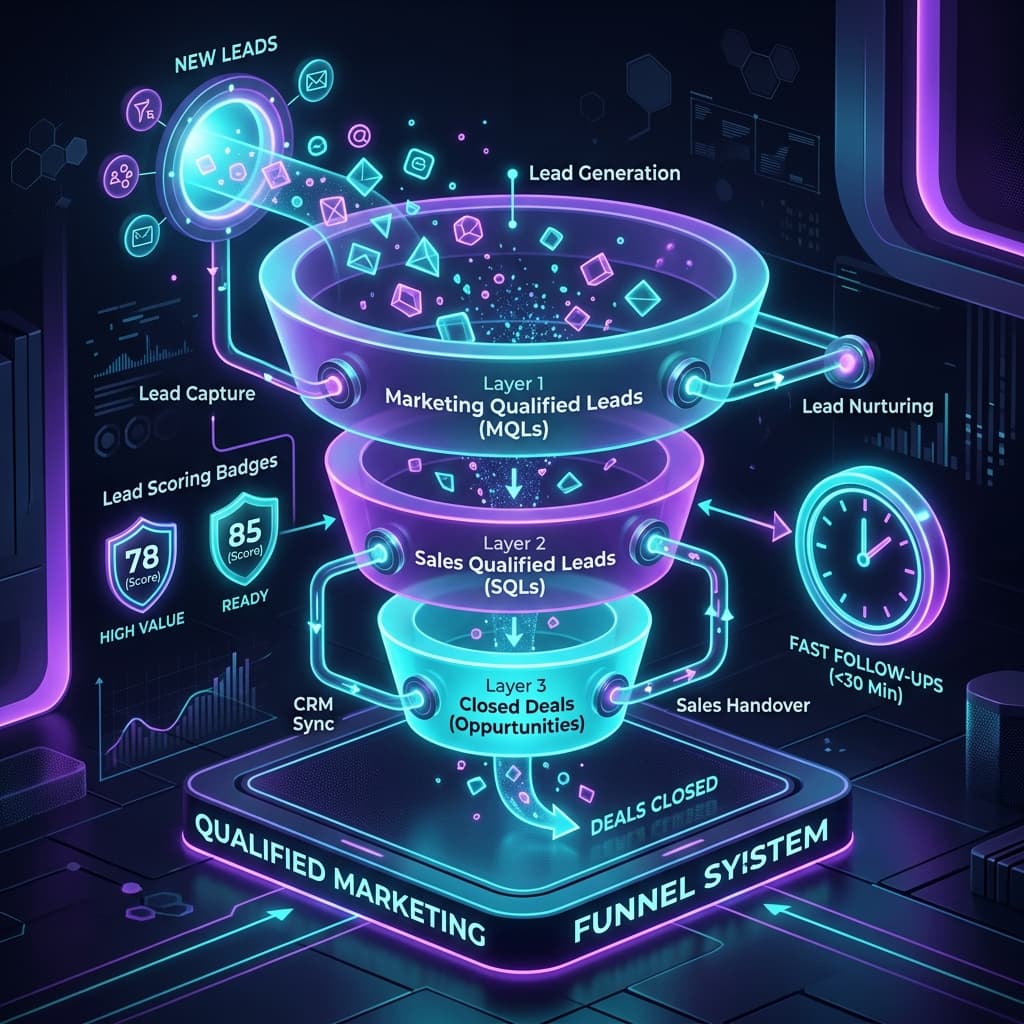
The Practical Framework: Fixing Conversion, Not Just Volume
The fix isn't a better AI tool. It's a system that makes sure every lead AI brings in has somewhere useful to go. Here's the four-part framework.
Part 1: Define Your Buyer Before You Define Your Prompt
Most AI underperforms because the targeting brief was vague — "small business owners interested in marketing," for example. That's not a buyer profile; it's a demographic. A usable buyer definition includes the specific problem they have right now, the signal that they're actively looking for a solution (not just a fit for one) and the disqualifiers that tell you someone is a poor match before you spend time on them.
Write this down before you generate a single lead. "Marketing agency owners with 3-15 employees who are actively hiring or have posted about being overwhelmed with client work in the last 60 days" is a brief an AI system can actually act on — and one that filters out the volume that was never going to convert in the first place.
Part 2: Build a Qualification Layer Before the Lead Reaches a Human
The single biggest time-waster in AI is sending every contact straight to a salesperson or your own inbox. Instead, build a lightweight scoring or qualification step — even a simple checklist — that separates "matches our buyer profile and shows active intent" from "technically fits the demographic but shows no signal of being ready." This is the same logic behind a basic lead scoring system: not every contact deserves the same amount of attention and treating them equally is what burns out a small team fastest.
Part 3: Build the Follow-Up Sequence Before You Turn On
This is the step most businesses skip — and it's the one responsible for the majority of lost conversions. A lead that isn't contacted within the first hour is dramatically less likely to convert than one that is. AI can draft the sequence: an immediate acknowledgment, a value-driven follow-up within 24 hours, a check-in a few days later and a re-engagement message for contacts who've gone quiet. What it can't do is exist without you building it first. If your current process is "leads land in a spreadsheet and someone gets to them eventually," more leads will only make that bottleneck worse.
Part 4: Review for Pattern, Not Just for Performance
Every 30 days, look at the leads that did convert and the ones that didn't — not to congratulate or blame anyone, but to spot the pattern. Are the converting leads coming from a specific source, role, or company size? Are the non-converting leads sharing a trait your targeting brief should have excluded? This is where AI becomes genuinely useful again: feeding it your conversion data and asking it to identify the traits that separate your best leads from your worst is a fast way to sharpen the targeting brief for the next cycle.
Real-World Example: A Consulting Firm Cuts Lead Volume by 60% — and Doubles Conversions
A small consulting firm turned on an AI tool expecting it to fill their calendar. It did — they went from roughly 20 leads a month to over 90. Their close rate, however, dropped from 1-in-8 to roughly 1-in-30. More leads, fewer clients and a founder spending entire afternoons on discovery calls that went nowhere.
The fix wasn't a new tool. It was rebuilding the system around the one they had. They rewrote their targeting brief to include a specific, current trigger ("recently posted about scaling challenges" rather than "fits our general industry"), added a short qualification questionnaire before any call got booked and built a same-day follow-up sequence for anyone who showed initial interest but didn't book immediately.
The result: lead volume dropped by roughly 60% — but the leads that remained were dramatically more likely to convert. Their close rate climbed back above 1-in-10 and the founder got back the hours that used to go into low-value discovery calls. The lesson wasn't "use AI less." It was "stop measuring success by how many leads show up and start measuring it by how many of them were ever going to buy."
This is the exact gap AgentMinds closes for clients — not just turning on but building the qualification and follow-up system that determines whether those leads turn into revenue.
Common Mistakes That Sink AI
- Mistake 1: Optimizing for lead count instead of lead fit. A bigger number feels like progress. It usually isn't. If your close rate drops faster than your lead count rises, you're generating noise, not pipeline.
- Mistake 2: Sending every lead to a human immediately. This burns your team's time on contacts that were never going to convert and slows down the response time for the ones that would have.
- Mistake 3: Skipping the follow-up sequence entirely. A lead that shows interest and then hears nothing for four days has usually moved on. AI can generate volume; it can't make up for a follow-up gap that's been there the whole time.
- Mistake 4: Treating "AI-generated" as a quality guarantee. AI is a force multiplier on whatever targeting brief you give it. A vague brief, multiplied, produces a large volume of vague-fit leads — faster than you could have produced them manually.
- Mistake 5: Never closing the loop between sales outcomes and targeting. If your sales team knows which leads convert and that information never makes it back into your targeting brief, you're running the same underperforming process on a larger scale every month.
Action Plan: Fix Your Funnel This Week
- Step 1:Write a one-paragraph buyer definition that includes the specific problem, the active-intent signal and your disqualifiers. If you can't write it in one paragraph, your targeting brief isn't ready yet.
- Step 2:Audit your current follow-up process. How long does it take a new lead to hear from you? If the honest answer is "more than an hour," that's your highest-leverage fix — before you generate a single new lead.
- Step 3:Build (or have AI draft) a four-touch follow-up sequence: immediate acknowledgment, value-driven follow-up, check-in, re-engagement.
- Step 4:Add one qualification step before any lead reaches a calendar or inbox — even a three-question form.
- Step 5:Pull your last 90 days of lead data and look for the pattern that separates conversions from dead ends. Feed that pattern back into your targeting brief.
- Step 6:Re-measure in 30 days — not by lead count, but by close rate and hours spent on dead-end conversations.
If building this system sounds like more than you want to take on solo, this is precisely what AgentMinds installs for clients: the targeting brief, the qualification layer and the follow-up sequence that turns AI-sourced volume into an actual pipeline.
Frequently Asked Questions
1. Why are my AI-generated leads not converting?
Almost always one of three reasons: the targeting brief was too broad, the underlying data was outdated or mismatched to your real buyer, or there's no follow-up system to move an interested contact toward a sale. AI increases volume — it doesn't fix what happens after the lead arrives.
2. Is AI actually worth it for small businesses?
Yes, but only when it's paired with a qualification and follow-up system. On its own, it's a volume tool. Combined with a clear buyer definition and a fast follow-up sequence, it becomes a genuine pipeline driver.
3. How do I know if my lead quality problem is a targeting problem or a follow-up problem?
Look at how quickly you respond to new leads. If your average response time is hours (not minutes) and your close rate is low, fix follow-up first — it's usually the bigger and faster win. If response time is fast and conversion is still low, the targeting brief needs work.
4. What's a realistic close rate for AI-generated leads?
It varies by industry, but the benchmark that matters is your own — compare your AI-generated lead close rate to your close rate from referrals or other sources. If it's significantly lower, the gap is almost always in targeting specificity or follow-up speed, not the AI tool itself.
5. Should I slow down my AI if conversions are low?
Often, yes — temporarily. Reducing volume while you fix targeting and follow-up usually produces better results than scaling a broken process. More leads through a broken funnel is more wasted time, not more revenue.
6. How fast does lead follow-up need to be to make a difference?
The first hour matters more than any other window. A lead contacted within the first hour is significantly more likely to engage than one contacted the next day. If your current process can't hit that, automating the first response is the highest-leverage fix available.
7. Can AI help me figure out which of my current leads are actually worth pursuing?
Yes — this is one of its strongest practical uses. Feed it your past conversion data and ask it to identify the traits shared by leads who converted versus leads who didn't. That pattern becomes the foundation of a better qualification step.
8. What's the biggest mistake businesses make when they first turn on AI ?
Measuring success by lead count instead of close rate. A jump in leads feels like momentum. If it's not paired with a jump — or at least a hold — in conversions, it's adding work, not value.
9. Do I need a CRM to fix this, or can I do it with simple tools?
You don't need an enterprise CRM. A well-organized spreadsheet with a clear qualification column and a documented follow-up cadence is enough to start. The system matters more than the software running it.
10. How long does it take to see the impact of fixing the targeting and follow-up system?
Most businesses see a measurable shift in close rate within 30 days of tightening their targeting brief and putting a real follow-up sequence in place — often with fewer total leads but a noticeably higher percentage actually converting.
Related Reading
- Why Your AI Agent Keeps Failing After Week Two (And How to Fix It)
- AI for Small Businesses: How to Build a System That Finds Clients While You Sleep
- How to Automate Lead Follow-Up With AI (And Stop Losing Sales to Slow Response Times)
If your pipeline is full but your calendar isn't, the fix usually isn't more leads — it's the system around them. AgentMinds builds the targeting, qualification and follow-up systems that turn AI-sourced volume into revenue. Book an Automation Audit to find the gap in yours.