Claude Code for Marketers: How Non-Developers Are Automating Growth (2026 Guide)
Direct answer: Claude Code is Anthropic's agentic coding tool, but you don't need to know how to code to use it for marketing. Marketers are using it to batch-generate ad variants, build and deploy landing pages, pull campaign data into reports and automate repetitive production work — all by describing what they want in plain English. The tool reads files, runs the steps and fixes its own mistakes, which means it behaves less like software you operate and more like a contractor you brief.
Why This Matters Right Now
Search interest in "marketing skills claude" has hit breakout status in the last 90 days — running at roughly 25 times the volume of generic "Claude for marketers" searches. That's not a curiosity spike. That's a sign that marketers have started actively looking for ways to use Claude Code for production work, not just chat-based brainstorming.
Here's what's driving it: Claude Code was built for developers, but its core skill — taking a plain-language instruction, breaking it into steps, executing those steps against real files and tools and correcting itself when something goes wrong — has nothing to do with programming specifically. It's a skill that applies to any repetitive, structured work. Marketing is full of repetitive, structured work.
Until recently, the gap between "I have an idea for a campaign tool" and "I have a working campaign tool" required a developer. That gap is closing. Marketers are now building things that used to require an engineering ticket: custom calculators, batch ad generation pipelines, landing pages, reporting dashboards that pull from multiple sources. Not because they learned to code — because the tool translates their instructions into working output.
This matters for AgentMinds' audience specifically. Small businesses, agencies and solopreneurs have never had in-house developers. That used to mean every "build us a tool" idea died in a quote from a freelance developer. Claude Code removes that bottleneck — if you know how to brief it.
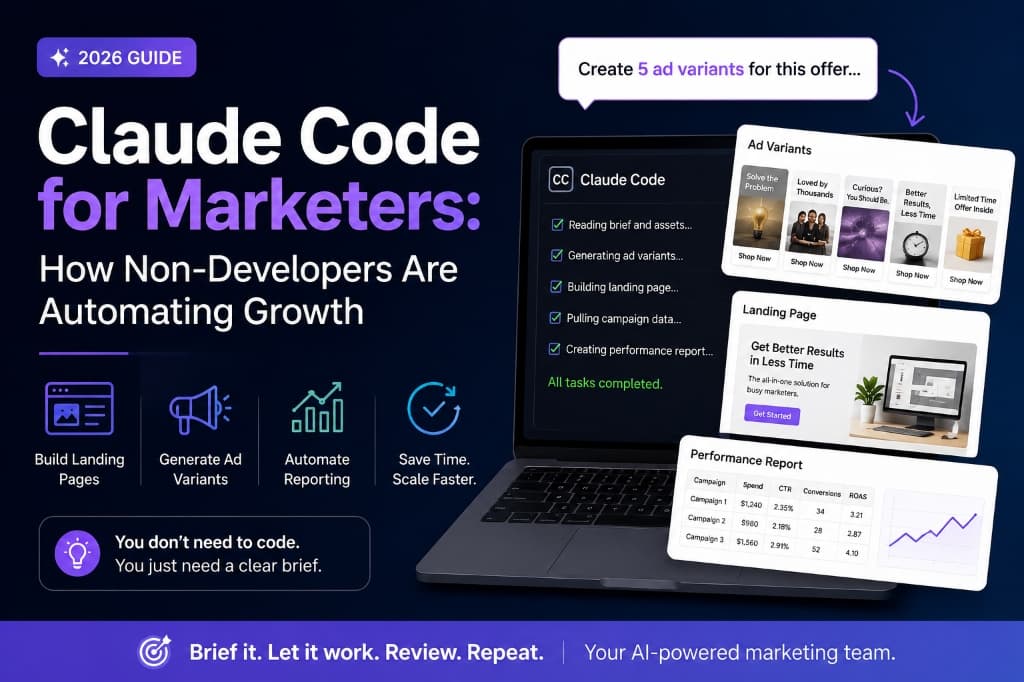
The Practical Framework: Briefing Claude Code Like You'd Brief a Contractor
The biggest misconception is that using Claude Code requires technical fluency. It doesn't. It requires the same skill you already use to brief a freelancer or a new hire: being specific about the outcome, the constraints and what "done" looks like. Here's the framework that separates marketers who get useful output from marketers who get stuck.
Step 1: Start With a Production Bottleneck, Not a "Cool Idea"
Don't open Claude Code looking for something impressive to build. Open it with a specific, recurring task that currently eats your time. Ad variant production. Landing page drafts for every new offer. Weekly performance summaries pulled from three different platforms. The clearer the bottleneck, the clearer the brief — and the more obvious it is whether the output actually worked.
Step 2: Describe the Outcome, the Inputs and the Format
A weak brief: "Help me make some ad copy."
A strong brief: "I have 12 product descriptions in this folder. Generate 5 ad variants for each — one benefit-led, one problem-led, one social-proof-led, one curiosity-led and one direct-offer — and save them as a spreadsheet with columns for product name, angle and copy."
The second version gives Claude Code everything it needs to execute without guessing. The quality of your output is a direct function of the clarity of your input.
Step 3: Let It Work in Small, Checkable Batches
Don't ask for "the whole campaign." Ask for one piece, review it, then scale. The first batch tells you whether your brief was clear and whether the tool understood your brand voice and constraints. Once the first batch is right, scaling to 50 or 100 variants is a matter of repetition, not redoing the work.
Step 4: Build the Repeatable Version
Once you've gotten good output from a clear brief, the next move is turning that brief into something reusable — a template prompt, a saved workflow, a documented process your team (or AgentMinds, if you're working with us) can run again next month without rebuilding it from scratch. This is where the real time savings compound: the first ad batch might take an hour to get right. The fifth batch takes ten minutes because the brief is already proven.
Step 5: Keep a Human on Anything Customer-Facing
This is the line that separates marketers who build durable systems from marketers who create cleanup work. Claude Code can draft the landing page, generate the ad copy and assemble the report. A human should review anything that goes in front of a customer or prospect before it ships. The tool accelerates production. It doesn't replace judgment.
Real-World Example: A Two-Person Agency Cuts Ad Production From 30 Minutes to 30 Seconds Per Variant
Consider a small marketing agency running paid social for six clients. Their bottleneck wasn't strategy — it was production. Every campaign needed 8-10 ad variants per client and writing each one manually took roughly 30 minutes once you accounted for copywriting, formatting and getting it into the ad platform's required structure.
Using Claude Code, the team built a simple, repeatable process: feed it the client's brand brief, the offer details and five proven angle types (the same ones outlined in Step 2 above). Claude Code generates a full batch — copy, headline variants and platform-formatted output — in minutes. The team reviews, tweaks two or three lines per variant for voice and accuracy and ships.
The result: what used to take 4-5 hours per client per campaign now takes about 45 minutes of review time. That's not a 10% efficiency gain — it's the difference between being able to serve six clients and being able to serve eighteen, with the same headcount. The agency didn't hire a developer. They didn't change their service offering. They changed how the production layer of their business works.
This is the pattern AgentMinds builds for clients directly: identifying the highest-volume, most repetitive part of a marketing operation and turning it into a system that runs with a brief and a review pass — not a rebuild every time.
Common Mistakes Marketers Make With Claude Code
- Mistake 1: Treating it like a chatbot instead of a production tool. Asking it open-ended questions ("what do you think of this campaign?") gets you opinions. Briefing it on a specific, structured task ("generate 10 variants in this format from these inputs") gets you finished work. The tool is most valuable when you treat it as something that executes, not something that chats.
- Mistake 2: Skipping the brand voice setup. If you don't tell it what your brand sounds like — tone, words to avoid, examples of copy that worked — it will default to generic marketing language. The first batch from any new brief should always include a voice calibration pass.
- Mistake 3: Asking for too much in one shot. A brief that tries to cover ideation, drafting, formatting and distribution in one go usually produces something that's mediocre at all four. Break it into stages, check each one, then chain them together once each stage is solid.
- Mistake 4: Publishing without review. This is the most expensive mistake on the list. Claude Code is fast and generally accurate, but "generally accurate" is not the same as "ready to represent your brand publicly." Build the review step into your process from day one — not as an afterthought once something goes out wrong.
- Mistake 5: Never turning a win into a system. A marketer gets a great batch of ad copy once, uses it and starts from scratch next time. The compounding value comes from documenting what worked — the brief structure, the inputs, the review checklist — so the second and tenth run are faster than the first.
Action Plan: Your First Week With Claude Code
- Step 1: Pick one bottleneck. Choose the single most repetitive, time-consuming production task in your marketing operation — not the most exciting one.
- Step 2: Write one detailed brief. Include the outcome, the inputs, the format and your brand voice notes. Treat it like onboarding a new freelancer.
- Step 3: Run a small batch first. Five items, not fifty. Review every one.
- Step 4: Document what worked. Save the brief structure that produced good output. This becomes your reusable template.
- Step 5: Add a review checkpoint. Decide, in writing, what gets human review before it ships — and don't skip it under deadline pressure.
- Step 6: Scale only after the small batch is right. Once the process is proven at five, ten and fifty are just repetition.
If you'd rather have this built for you — brief structure, review process and the production system wired into your existing workflow — that's exactly the kind of system AgentMinds designs and installs for clients.
Frequently Asked Questions
1. Do I need to know how to code to use Claude Code for marketing?
No. Claude Code interprets plain-language instructions and executes them. The skill that matters is briefing clearly — describing the outcome, the inputs and the format you need — the same skill you'd use to brief a freelancer.
2. What's the difference between Claude Code and Claude CoWork for marketing tasks?
Claude Code is built around executing structured, file-based, repeatable production work — generating batches of content, building pages, assembling reports from data. Claude CoWork is built around running broader business workflows and connecting to tools you already use (CRM, email, project management). Many marketing teams use both: CoWork for ongoing operational workflows, Claude Code for production-heavy, batch-style tasks.
3. What kinds of marketing tasks is Claude Code actually good at?
Batch content generation (ad variants, product descriptions, email copy), building and deploying simple landing pages, assembling reports that pull from multiple data sources and automating repetitive formatting or reformatting work. It's strongest on tasks that are structured and repeatable.
4. Can Claude Code replace a marketing team?
No and treating it that way is how things go wrong. It removes the production bottleneck — the part of marketing that's repetitive and time-consuming — so your team can spend more time on strategy, positioning and the judgment calls AI shouldn't make alone.
5. How long does it take to see results from using Claude Code in a marketing workflow?
Most teams see a usable first batch within the first session, once the brief is clear. The real time savings show up after the second or third run, when the brief becomes a reusable template and the process speeds up each time.
6. Is Claude Code safe to use for customer-facing content?
It's safe to use for drafting customer-facing content. It's not safe to publish without a human review step. Build that checkpoint into your process from the start — it's the difference between accelerating your marketing and creating cleanup work.
7. What's the most common reason marketers give up on Claude Code too early?
Vague briefs. Asking for "some ad ideas" produces generic output that feels unimpressive. Asking for a specific batch, in a specific format, based on specific inputs, produces finished work. The tool is only as useful as the clarity of the instruction it receives.
8. Do I need special tools or a developer to set this up?
No. Claude Code runs in an environment that reads your files and executes tasks directly — no separate developer setup required for the kinds of tasks described in this guide. If you want it integrated into a broader operational system (CRM, reporting, content pipeline), that's where a structured setup — like the ones AgentMinds builds — adds the most value.
9. What should my first project with Claude Code be?
Pick the task you currently dread doing every week — the one that's repetitive, time-consuming and not strategic. That's almost always the best starting point, because it's specific enough to brief clearly and valuable enough that getting it right matters.
10. How do I know if Claude Code is actually saving me time, or just shifting the work around?
Track two numbers for 30 days: how long the task used to take you manually and how long it takes you now (including the review step). If the second number is meaningfully lower and the output quality holds, it's a real gain. If you're spending as much time reviewing and fixing as you used to spend doing it manually, the brief — not the tool — needs work.
Related Reading
- Why Your AI Agent Keeps Failing After Week Two (And How to Fix It)
- AI Marketing Automation for Solopreneurs: How to Run a Full System Solo in 2026
- How to Build an AI Content Automation System for Small Business
Want a Claude Code or Claude CoWork production system built around your specific marketing bottlenecks? That's what AgentMinds does — book an Automation Audit and we'll map the highest-leverage place to start.