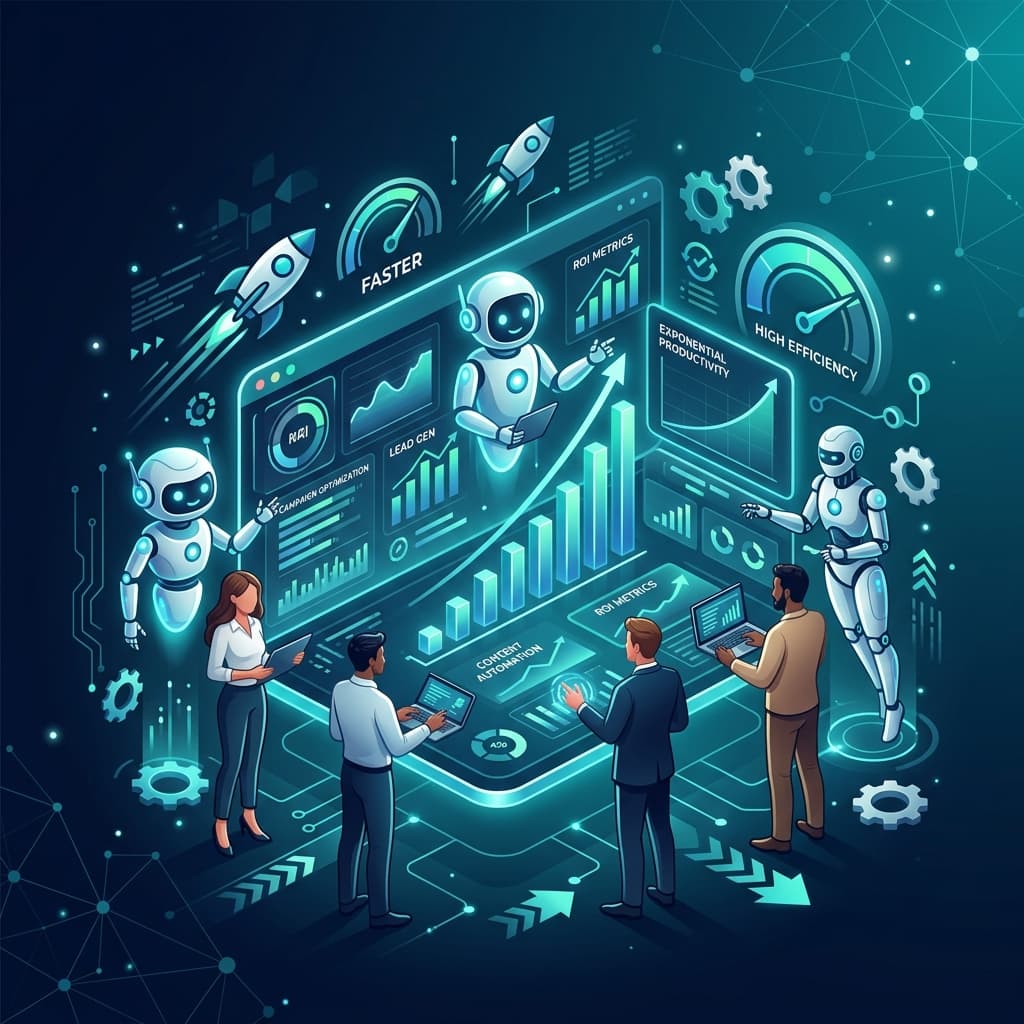
The marketing landscape is evolving rapidly and teams are constantly searching for ways to streamline workflows and boost productivity. Enter AI agents – autonomous systems that are revolutionizing how marketing teams operate. Unlike basic chatbots or rule-based tools, these intelligent systems can handle end-to-end processes and the results speak for themselves: MIT research with over 2,300 participants found that human-AI teams achieved a remarkable 60% higher productivity per employee on collaborative marketing tasks.
But what does this mean for your marketing team in practical terms? Let's explore how AI agents are transforming marketing workflows and delivering measurable results that allow teams to shift from execution to strategy and creativity.
Five Ways AI Agents Accelerate Marketing Workflows
1. Automation of Repetitive Tasks
AI agents excel at handling time-consuming, repetitive tasks that traditionally bog down marketing teams. They can autonomously manage lead nurturing sequences, adjust ad budgets based on performance metrics and conduct content quality assurance for brand voice and grammar across hundreds of assets. This automation of marketing operations saves hours of manual work and significantly reduces human error, allowing marketers to focus on higher-value strategic initiatives.
2. Predictive Campaign Management and Optimization
Unlike static marketing tools, AI agents continuously analyze real-time data including customer behavior, market trends and campaign performance. They can predict potential issues before they arise, flag underperforming campaigns, recommend budget reallocations and trigger automatic adjustments. This capability shifts teams from reactive firefighting to proactive strategic planning, ensuring campaigns stay on track without constant manual monitoring.
3. Content Creation and Personalization at Scale
AI agents can generate multiple content variants tailored to different personas and geographic regions simultaneously. They adapt content formats, personalize messages based on user behavior and optimize for audience resonance – all while maintaining brand consistency across touchpoints. This parallel processing capability dramatically accelerates time-to-market, compressing content development timelines from weeks to hours.
4. Lead Qualification and Journey Orchestration
These intelligent systems excel at scoring leads using behavioral and firmographic data, routing them to the appropriate sales representatives and adapting customer journeys dynamically based on real-time interactions. According to Salesforce's research on agentic marketing, these systems enable marketing teams to make mid-campaign adjustments without human intervention, ensuring optimal lead progression through the sales funnel.
5. Enhanced Team Collaboration and Experimentation
AI agents can parallelize workflows, summarize meeting outcomes into actionable briefs, coordinate seamlessly with sales teams and run continuous 24/7 optimizations across multiple channels. This multiplies team impact without requiring additional headcount, enabling lean teams to accomplish more than ever before.
Real-World Impact and Performance Metrics
The productivity gains from AI agents are backed by compelling data. McKinsey estimates that agentic AI could drive 3-5% annual productivity improvements and generate 10%+ growth lifts in marketing by handling complex decisions like price optimization, lead advancement and personalized offer creation. Early adopters are already experiencing faster campaign execution and higher team satisfaction across the board.
The MIT study revealed additional insights about work quality improvements: teams using AI agents sent 23% fewer social messages (reducing noise and improving focus), dedicated 23% more time to content creation activities like writing and image generation and spent 20% less time on text editing. These metrics demonstrate that AI agents don't just work faster – they help teams work smarter.
Perhaps most significantly, agentic AI is projected to power over 60% of AI's value in marketing deployments, enabling scaled, collaborative actions that go far beyond simple assistance.
Transforming Marketing Roles and Team Dynamics
AI agents are fundamentally changing how marketing teams operate and what roles look like. Marketing professionals are evolving from "task executors" to "AI orchestrators" and creative directors, with AI handling operational activities like campaign setup, data tagging and performance reporting – tasks that historically consumed the majority of a marketer's time.
This transformation allows lean teams to complete more tasks at scale while achieving better ROI through continuous insights and reduced bottlenecks from juggling multiple tools and platforms. The result is a more strategic, creative marketing function that can respond quickly to market opportunities and customer needs.
The Bottom Line: Faster, Smarter Marketing
AI agents represent a fundamental shift in how marketing teams can operate, moving beyond simple automation to intelligent collaboration that enhances human creativity and strategic thinking. With proven productivity gains of 60% and the potential for significant growth improvements, these tools are becoming essential for competitive marketing organizations.
The question isn't whether AI agents will transform marketing – it's how quickly your team can adapt to leverage these powerful capabilities. The data is clear: teams that embrace AI agents today will be the ones setting the pace for the industry tomorrow.
Ready to supercharge your marketing team's productivity? AgentMinds ↗ offers 60+ AI marketing automation agents built on n8n – a full digital workforce for campaign analysis and workflow management. One-time setup, no recurring subscriptions.