AI Agent vs AI Automation: What's the Real Difference for Marketing Teams
When you're shopping for a tool to handle your marketing workload, you'll hear both terms thrown around like they mean the same thing. They don't. And the difference matters more than you think, especially if you're trying to scale without burning out your team.
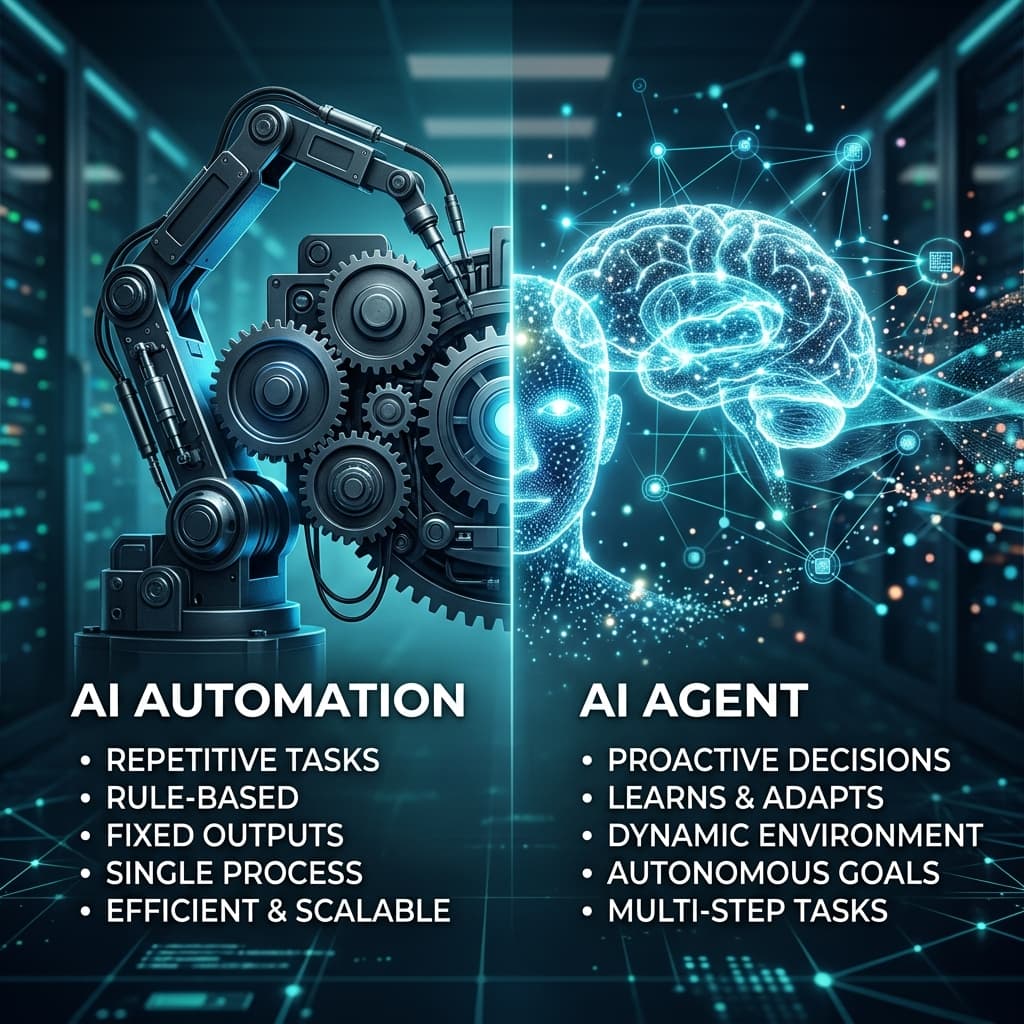
Let's cut through the noise.
What Is AI Automation?
AI automation follows a straight line. You set up a rule: "If X happens, do Y." The system executes it, every time, exactly the same way.
Real example: A form submission triggers an email. A lead hits a score threshold and they move to a nurture sequence. Data from column A copies to column B. It's predictable, repeatable and relies on conditions you define upfront.
The strength of automation is speed and consistency. It handles high volume without human intervention. But here's the catch: it can't think. The moment something falls outside your rule set, it fails.
You set up automation to send follow-up emails to "warm leads." But what happens when a lead shows interest in one product but your automation only knows about another? What if the tone needs to shift based on the customer's industry or company size? Automation stops. It doesn't adapt. It doesn't reason. It just breaks or does the wrong thing.
For marketing teams, that means:
- Rigid workflows that demand perfect data upfront
- No course correction mid-campaign
- Constant manual fixes when conditions don't match your predictions
- Scaling volume, not complexity
Automation is the treadmill. It runs faster but always stays in place.
What Is an AI Agent?
An AI agent is something else entirely. It observes, reasons and acts.
An agent doesn't just follow a rule. It processes context. It asks questions about what it's seeing. It adapts its approach based on what the data actually shows, not what you predicted it would show.
Real example: An agent receives a brief to write email copy for three audience segments. It doesn't just generate the same email three times. It researches each segment's pain points, adjusts tone and messaging accordingly, tests different angles and flags which versions are most likely to land. It doesn't wait for perfect input. It works with what exists and fills gaps with reasoning.
An agent can handle multi-step workflows where the steps aren't predetermined. It can prioritize. It can say, "Based on what I'm seeing, the strategy should shift." It operates with some degree of autonomy within guardrails you set.
For marketing teams, that means:
- Workflows adapt to real data
- Multi-channel campaigns that adjust on the fly
- Reasoning applied to strategy, not just execution
- Scalability of complexity, not just volume
Agents are the thinking partner. They move faster and smarter.
Head-to-Head Comparison
Flexibility and Adaptation
Automation works best with predictable inputs. You design the flow, it executes the flow. If something unexpected happens, it either stops or does the wrong thing. Agents work with messy, real-world inputs. They adjust their approach based on what they encounter.
Example: Your automation expects all product descriptions to follow the same format. If one doesn't, it breaks. An agent reads whatever description exists, understands what product it's talking about and generates compliant copy anyway.
Decision-Making Capability
Automation executes decisions you made before it started running. It's reactive. An agent makes decisions during execution. It can weigh options, consider trade-offs and choose the best path forward based on current conditions.
Example: An automation rule sends discount codes to inactive users. An agent would first check: Is this user inactive because they don't like our product, or because they haven't seen recent campaigns? Should we send a discount, or re-engagement content? The agent reasons. The automation just fires.
Setup Complexity
Automation is simpler to set up initially. Point A to Point B. Done. But simplicity breaks fast when you need nuance. Agents require more upfront thinking about what outcomes you want, but the payoff is you don't need to reconfigure every time something changes.
Cost Structure
Automation tools often charge per workflow or per execution. They're cheap at low scale, expensive at high scale because you're paying volume fees. Agents typically charge per capability or per seat. They're better for teams that need depth, not just speed.
Scalability
Automation scales volume until it doesn't. The more workflows you add, the more rules you manage, the more breakage. Agents scale complexity. Add a new market or product line and an agent adapts. Add a new workflow to an automation platform and you're rebuilding.
Human Control Requirements
Automation is "set and forget" — which sounds good but means you lose visibility. By the time you notice something broke, damage is done. Agents work best with human-in-the-loop: the system generates output, your team approves it, then it goes live. You stay in control without losing speed.
Why Marketing Teams Need Agents, Not Just Automation
Most marketing workflows aren't simple. You're not just moving data. You're making judgment calls.
Should this email go out today or tomorrow? Does the subject line match the audience segment? Should we prioritize SEO or paid ads this week based on current traffic trends? Is this campaign copy on-brand?
Automation can't answer any of that. It can only execute what you told it to do three weeks ago when you built the workflow.
An agent can reason through these questions. It processes context, weighs options and proposes the best path. Your team reviews the proposal and approves or adjusts. That's the difference between "fire and forget" and "smart and controlled."
Real scenario: Your automation sends the same weekly email to everyone on your list. Your agent could segment that list by engagement level, generate tailored content for each segment and flag which segments need different offers or messaging entirely. Then your team reviews and publishes.
Automation handles the repetition. Agents handle the thinking. Most marketing work requires thinking.
The Human-in-the-Loop Factor
Here's what most AI platforms miss: they want to be fully automatic. Push a button, the AI does everything, no human needed.
That sounds efficient. It's not. It's dangerous.
Pure automation removes human judgment from marketing, which means errors scale fast. Wrong tone on a customer-facing email? Thousands of people see it before you notice. Misaligned campaign messaging? Same problem.
Full automation is a black box: you don't know why the system made certain choices. You can't override it if it's wrong. You just have to trust it worked.
Agents with Human-in-the-Loop flip that. The agent does the work, your team reviews the output, then you decide if it goes live. Speed meets control.
You get the efficiency of AI without losing your editorial voice or the ability to catch mistakes before they become reputation damage. That's critical for marketing teams. Your brand is on the line. The tool should help you move faster, not remove you from the process.
Which Should You Choose?
- If you have simple, repetitive tasks: automation. Form submissions go to one email. New leads get added to a spreadsheet. These workflows don't change.
- If you have complex, multi-step marketing operations: agents. Content needs to adapt by audience. Campaigns need to adjust based on performance. Strategy shifts based on data.
Most marketing teams need both. But agents are what separates scaling from staying stuck.
The truth: you can automate yourself into a corner. You build more workflows, hire more people to manage them and suddenly you're not saving time anymore. Agents let you automate the thinking, not just the clicks.
That's where teams actually scale.
Start building smarter marketing workflows.
AgentMinds combines 89+ specialised agents with Human-in-the-Loop control, so your team stays in charge while AI handles the heavy lifting.
Try Free